LSD Blotters (Lysergic acid diethylamide )— more commonly referred to as LSD or acid — is one of the most popular psychedelic drugs in existence. Anyone who has had the chance to take LSD or has started to do research on dosing has probably heard of blotters (also called blotter paper). In this guide, you’ll learn what blotters are, how to take them safely, what the dosage looks like, and what steps you should take to ensure a safe and positive experience overall.
We’ll also touch on the concept of LSD blotter art.
What Is an LSD Blotter?
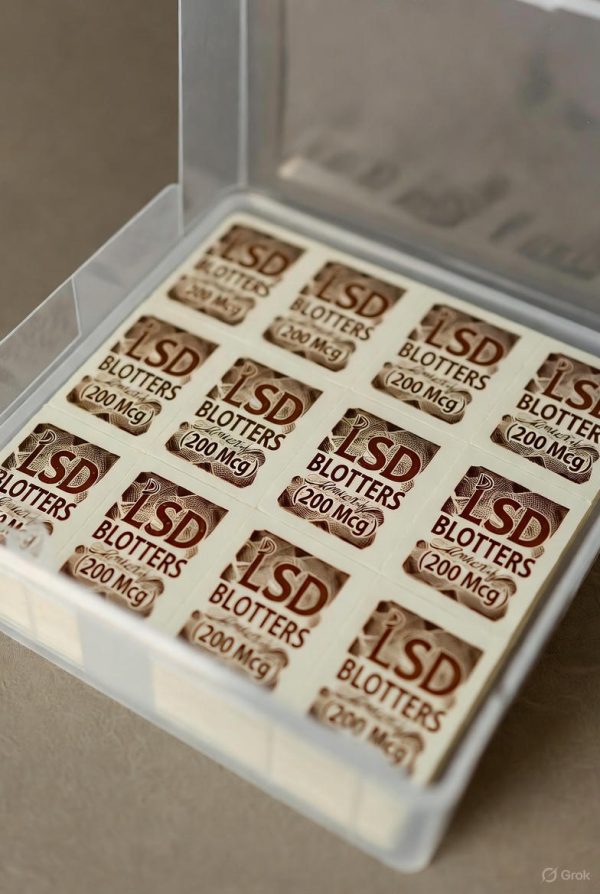
An LSD blotter is a small tab of absorbent paper onto which liquid LSD has been soaked.
Blotter paper is one of the most common methods of dosing for LSD for a few reasons:
It makes dosing LSD much safer and more accurate
Blotter paper is easier to store and distribute
Blotter paper has a long shelf-life
Blotter paper also makes storing LSD more straightforward, even for long periods.
Blotters are usually made into large printed sheets with distinct imagery, called LSD blotter art. This acts like the branding for that particular batch of acid and its manufacturer.
History of Blotter Art
The fascinating history of blotter art began in the late 1960s as a clever solution to a growing distribution problem. Initially, producers distributed liquid acid on sugar cubes or plain paper; however, these methods lacked branding and visual appeal. Consequently, underground chemists started printing intricate designs on perforated paper to distinguish their specific “brands.” By the 1970s, artists like Mark McCloud transformed these functional sheets into a legitimate underground art movement, often featuring iconic symbols like the “Yellow Submarine” or “Mr. Natural.” Furthermore, the introduction of high-quality offset printing allowed for increasingly complex and psychedelic imagery. This evolution turned a simple delivery system into a collectible medium that captured the cultural zeitgeist of the era. Today, blotter art remains a cherished symbol of counter-culture history, representing a unique bridge between chemistry, clandestine marketing, and visionary graphic design.
How Do You Take A Tab of Acid?
Blotters (tabs) are the most popular dosing method for using LSD because of how easy they are to use. A newer method called LSD gel tabs follows a similar approach and has become more popular in recent years as well.
Most users drop a single tab or a part of a tab under the tongue and hold it there for 10 minutes or so.
Some users swear by holding the tab sublingually for 45 minutes, but anecdotal evidence suggests no difference in effects after just 10 or 15 minutes.
After the first 10 minutes, swallow the blotter or take it out of your mouth and throw it out.
Again, there are no reported differences in effects between removing the blotter paper and swallowing it.
You can also cut each tab into smaller pieces using a sharp knife. Common denominations include half or a quarter of a tab.
For microdosing LSD, tabs should be cut into 9 even squares. The standard microdose is about 10% of a standard dose. You can choose to cut the tabs into 10 squares to be more accurate, but 9 is close enough and is much easier to divide evenly.
What Do Blotters Taste Like?
LSD blotters shouldn’t taste like anything. Pure LSD doesn’t have any taste or smell. If you notice a bitter or unpleasant flavor, or you notice that the area of your mouth where you’re keeping the blotter paper feels tingly or numb, chances are your blotter doesn’t contain pure LSD.
If you notice a clear taste from your blotter, take the tab out immediately. It could contain a compound called 25I-NBOMe, which has similar effects as acid but is much more dangerous.
You can avoid this issue altogether by testing a small piece of your blotter square with a reagent test kit prior to taking it (highly recommended).
How to Store LSD Blotters
To maintain the peak integrity of your LSD blotters, you must treat them with careful consideration for environmental factors. Primarily, three main enemies—light, heat, and oxygen—can rapidly degrade the delicate lysergic acid molecules. To combat these, you should first wrap your blotter paper tightly in tinfoil to block all UV exposure. Subsequently, place the wrapped paper inside an airtight container, such as a glass vial or a high-quality mylar bag, to prevent oxidation. Furthermore, store this container in a cool, dark place, such as a climate-controlled safe or a dedicated drawer. While some enthusiasts prefer the freezer for long-term storage, you must ensure the seal is perfect to avoid moisture damage from condensation. By following these rigorous storage steps, you effectively “freeze” the chemical state of your product, ensuring it remains potent and reliable for several years.
How to Take LSD Blotters Safely
LSD is generally considered a safe substance if it’s used properly. Taking the correct dose and being prepared for your trip are the best ways to ensure you have a positive trip.
Preparing yourself mentally and physically and ensuring you have the right “set and setting” are crucial for avoiding bad trips and negative experiences.
Here are some tips for using LSD blotters safely:
Always test a sample before you take it. Use the Ehrlich and Hoffmann reagents
Only take one tab if this is your first experience with LSD. Even if the effects take a long time to kick in, be patient and don’t double-dose.
Only use LSD if you’re with people you trust (and willing to remain sober throughout the journey).
Only take LSD if you’re in the right mindset (if you’re feeling depressed, worried, or anxious, it’s not wise to use LSD).
Only take acid if you’re in a safe and familiar location.
Clear your schedule for the day before you begin; it’s not a good idea to have important plans later, even if the effects are supposed to be worn off in time.
Never take acid if you or a close family member have been diagnosed with psychosis or schizophrenia.
What’s the Proper Dosage When Taking LSD Blotters?
Bottom Line: One dose of LSD is equal to one full tab of acid. The potency of each tab can vary from one batch to the next.
LSD is extremely potent. It’s one of the few psychedelics active at a sub-milligram dose. This is why LSD is measured in micrograms rather than milligrams or grams. The threshold dose (the minimum amount needed for psychoactive effects) is only about 50 micrograms.
A standard LSD dose is around 80–100 micrograms. This dose will supply a somewhat potent psychedelic experience without too much risk of being overwhelming.
A single tab of LSD blotter paper is designed to contain roughly 100 micrograms each, but the actual dose can vary from about 80 to 140 mcg. It’s impossible to know the exact potency of the LSD tab without high-tech analysis equipment. This is why it helps to know from the source of the LSD how powerful it is based on others who have already tried a sample from the current batch.
All tabs that come from an individual LSD blotter art paper should have roughly the same potency.
Let’s break down the doses of LSD blotters:
Microdose — Anything under 20 mcg (most aim for 10% of the standard psychoactive dose). This works out to about 10% of a blotter square.
Threshold dose — The official threshold is listed at 50 mcg, but this can vary depending on the users size and sensitivity to LSD. This can range from 20 to 60 mcg.
Standard psychoactive dose — The usual dose of LSD is between 80 and 100 mcg (one full tab of LSD).
Heroic dose — This dose is not recommended. Anything over 200 mcg is considered a heroic dose. The effects of LSD at this dose are comparable to DMT.
Do LSD Blotters Lose Potency?
Yes, LSD blotters can and will lose potency if you do not protect them from the elements. Because the active compound sits on the surface of the paper fibers, it remains highly vulnerable to environmental degradation. For instance, prolonged exposure to direct sunlight or high room temperatures can cause the molecules to break down within just a few weeks. Furthermore, moisture and humidity can leach the compound out of the paper or encourage the growth of destructive mold. However, if you store them correctly in a cool, dark, and airtight environment, the rate of loss becomes almost negligible. Under ideal conditions, blotters can retain their original strength for many years. Consequently, the “shelf life” of your product depends entirely on your storage habits rather than a fixed expiration date. Therefore, investing in quality storage is the best way to guarantee a consistent experience.
How to Microdose LSD Using Blotters
Microdosing is very straightforward when using blotters. Since the standard micro dosing regimen calls for about 10% of the standard dose, and one standard dose is a full tab of acid — a microdose is achieved by cutting the tab into 10 even doses.
For the sake of simplicity, most people cut their tabs into 9 even squares by making two cuts vertically and two horizontally.
You can also make microdoses by infusing a tab of acid into some water and splitting it into ten even doses.
Why You Should Always Test Your LSD Blotters
Even if you take the ideal dose, you can have a bad or potentially dangerous experience if the blotter doesn’t contain pure LSD. Other hallucinogens that mimic the effects of LSD are sometimes sold without warning.
The only substances potent enough to be used as “fake LSD” are other lysergamides (which aren’t usually an issue) or NBOMes (these compounds are highly dangerous).
Because of the risk of NBOMe contamination, testing a small piece of your LSD is crucial to using it safely.
You can pick up simple LSD testing kits from places like Test Kit Plus. You should look for two tests — The Ehrlich reagent and Hoffmann Reagent.
It’s wise to use at least two individual tests for any substance you’re testing. Here’s what you should expect if your sample contains LSD:
Ehrlich — Should turn purple
Hoffmann — Should turn blue
If there’s no color change at all, your sample doesn’t contain LSD and should not be used.
In some cases, the Ehrlich reagent may turn pink. If this happens, it’s likely your tab contains a related lysergamide rather than LSD. These compounds are safe and often used as alternatives to LSD. However, the Hoffmann reagent should still turn blue. If not, don’t take it.
Tabernanthe Iboga vs. LSD
While both Tabernanthe iboga and LSD hold significant roles in the world of ethnobotanicals, they offer vastly different experiences and chemical profiles. Iboga, a powerful root bark from Central Africa, contains the alkaloid ibogaine, which functions primarily as a deep, dissociative tool for addiction interruption and spiritual initiation. In contrast, LSD is a semi-synthetic ergoline that targets serotonin receptors to produce vivid visual and cognitive shifts. Furthermore, an iboga journey can last up to 36 hours and often involves intense physical purging, whereas an LSD experience typically concludes within 12 hours with much less physical load. Consequently, researchers choose iboga for profound “ego-reset” and anti-addictive properties, while they prefer LSD for creativity, introspection, and sensory enhancement. Ultimately, although both substances facilitate deep psychological exploration, iboga acts as a heavy-duty therapeutic “root,” while LSD functions as a versatile, visionary
The Importance of Set & Setting
The last part of your preparation should be to perfect both set and setting.
“Set” refers to your mindset going into the LSD experience. LSD can help you access thoughts and feelings that you have suppressed or were entirely unaware of, so negative feelings about the drug or your trip could actually lead you to have a bad trip.
If you find yourself nervous about taking LSD, it’s best to step back and wait until you can honestly say you’re ready for the experience and you’re comfortable letting go and seeing where the drug takes you. Many people find that it’s helpful to set intentions for their trip by writing th