Psilocybe tampanensis: The Philosopher’s Stone Mushroom
Psilocybe tampanensis is famed for its ability to produce psychedelic sclerotia that are aptly nicknamed “Philosopher’s Stones.”
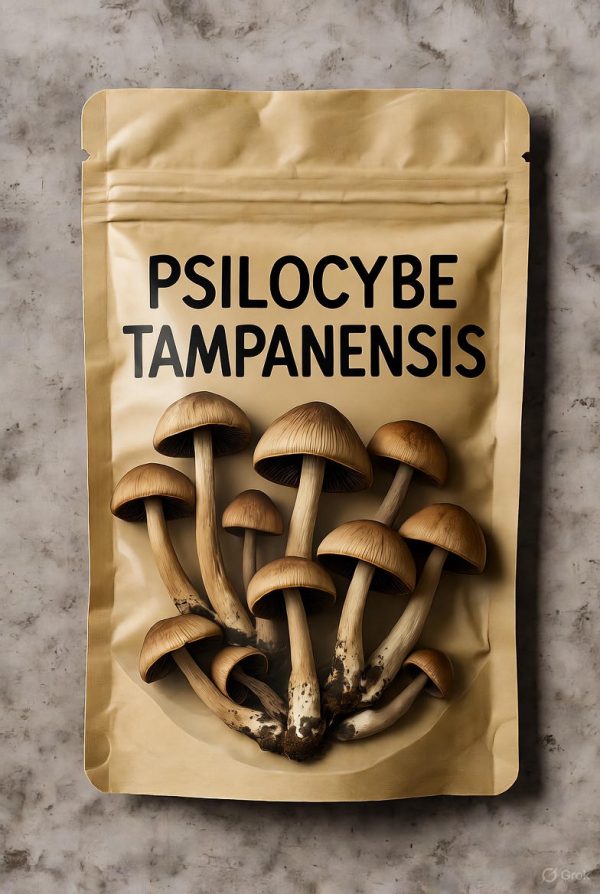
silocybe tampanensis is a peculiar species with underwhelming, small, brown mushrooms. What lies below the surface of these mushrooms is much more impressive. This species produces large masses of sclerotia — dense, truffle-like clumps of mycelium. As are the mushrooms, these “magic truffles” are psychedelic.
P. tampanensis was one of the first species cultivated for magic truffle production, and it kick-started the truffle market in the Netherlands, essentially saving the psilocybin scene when magic mushrooms were made illegal in 2008.
This mushroom species is loved by many, and it’s responsible for several important milestones in psychedelic history. Let me tell you more about it…
Psilocybe tampanensis is a rare psychedelic mushroom species originally collected from a meadow in Tampa, Florida, in 1977. Discovered by the legendary mycologist and “Mushroom Doctor” Steven Pollock, this species is unique in that it produces “sclerotia” (magic truffles) that can grow to enormous sizes.
Sclerotium is a mass of densely packed mycelium. In the psychedelic space, the sclerotia of psilocybin mushrooms are called magic truffles. However, they aren’t reproductive structures like traditional edible truffles are. Instead, these growths have the primary function of preserving the mushroom species through times of hardship.
Sclerotia can survive underground indefinitely — ensuring the longevity of the species. These clumps of mycelium can remain alive and dormant underground through long, harsh winters or periods of drought until conditions improve enough to support mushroom growth.
This species is often overlooked — they’re small, brown, and relatively unassuming. Even though P. tampanensis is largely cultivated, its mycelium is rarely left to fruit — cultivators are more interested in growing its sclerotia.
P. tampanensis mushrooms and truffles are relatively weak in terms of potency — producing psilocybin levels comparable to a low-potency strain of Psilocybe cubensis. That said, when over five grams of this species’ mushrooms or sclerotia are consumed, the user can experience deep introspection, an intense body high, and moderate visuals.
The History of Psilocybe tampanensis
The history of Psilocybe tampanensis is rather intriguing. There’s quite a story to this shroom, as it once disappeared entirely.
Let’s delve into the mysterious history of P. tampanensis and find out how it rose to fame…
1. Discovered in 1977
Psilocybe tampanensis was discovered in 1977 by none other than Steven Hyaden Pollock — a renowned mycologist who is often credited with the establishment of the famous Penis Envy strain of Psilocybe cubensis.
Pollock found the first sample of this rare Psilocybe species in Tampa, Florida — hence its species epithet “tampanensis.” He stumbled across the mushrooms while mushroom hunting in a sandy meadow grazed by Braham cattle with close friend and fellow mycologist Gary Lincoff. Although relatively boring in appearance, Pollock became rather intrigued with it.
He brought the specimen back to his remote Winnebago laboratory, where he dissected it and excised a small piece of stem tissue to an agar culture. While driving back from Tampa to his base in San Antonio, Pollock observed mycelial growth on one of the agar plates.
Some weeks later, he noticed something unusual about the Psilocybe tampanensis agar dishes. The mycelium began to glisten and form small, hard granules. He discovered a unique treasure that would change the course of his cultivation efforts entirely.
2. Strange Growths
Among the thin strands of web-like mycelium on his agar plates, several small lumps that looked like grains began to form. He left the plates undisturbed and observed them over several weeks.
The lumps grew larger and larger until they were the size of doorknobs. The masses of flesh had tinted shades of blue and purple. Pollock gave in and decided to experiment. He removed, dissected, and photographed the small lumps before boldly stepping into the unknown by eating them.
Pollock noted that the truffle-like growths tasted “nutty and tart” — a combination of kiwi fruit and cashew nuts. He also noted the telltale effects of the psychoactive compound psilocybin — the compound responsible for the hallucinatory effects of magic mushrooms.
Knowing he’d found something special, he called Lincoff to tell him they had discovered “the Philosopher’s Stone” in Tampa — and the iconic “magic truffle” was born.
Around one year later, in 1978, Steven Pollock and the Mexican mycologist Gastón Guzmán scientifically described the species and classified it as “Psilocybe tampanensis” in the Mycotaxon publication [1].
3. “Truffles the Size of Ostrich Eggs”
After discovering the Philosopher’s Stone, cultivating Psilocybe tampanensis became a priority for Steven Pollock. He wanted to bring these psychedelic truffles to the masses, believing that they could “transport the fortunate consumer to states of spiritual transcendence and jubilation far beyond the realm of ordinary psychedelics.”
From the minute he discovered the Philosopher’s Stone, he began developing a cultivation technique to produce masses of sclerotia. He set up a huge cultivation lab and perfected his technique.
Pollock began producing sclerotia from Psilocybe tampanensis, some of which grew to enormous proportions. In a 2011 Harper’s article, Gary Lincoff reported that some of Pollock’s Philosopher’s Stones grew to “the size of ostrich eggs” [2].
Pollock planned on selling Psilocybe tampanensis sclerotia via the mail service in the United States. He and his colleague, Michael Forbes, founded a company named “Hidden Creek” in 1979 to sell the truffles he produced. Pollock and Forbes advertised their company in the monthly issue of High Times magazine.
Pollock and Forbes successfully sold hundreds of P. tampanensis truffles through Hidden Creek, but the enterprise ended after a devastating turn of events.
4. A Sad & Abrupt End to the Philosopher’s Stone
In 1981, less than two years after Hidden Creek was founded, Pollock’s work came to a sudden end when he was tragically murdered in his home cultivation lab.
The 33-year-old was found dead in a pool of blood with a one-inch laceration on his forehead. His pocket linings were inside out, and a series of keys were scattered around his body in a “halo.” The house was turned upside down, and a collection of ornamental glass mushrooms was arranged on a chest beside his door.
Apparently, Pollock was found clutching a Penis Envy mushroom in each hand, but the crime report never detailed this. Either way, his murder was peculiar. It was ruled as an unfortunate burglary, but the person who killed Pollock appeared to be frantically searching for something in particular.
Over 1,753 spawn jars were recovered from Pollock’s cultivation lab, many containing mycelium of Psilocybe tampanensis. Ten pounds of ground P. tampanensis sclerotia were also recovered. Pollock had prepared them for analysis just days before his murder.
Walter Pollock (Steven’s father) warned the police that destroying his son’s work would be a grave mistake, believing the rare species he had discovered could harbor great medical value. Regardless, the DEA destroyed everything related to the illicit mushrooms, and so Pollock’s life work and the Philosopher’s Stone legacy abruptly ended.
Walter Pollock contacted his son’s business partner, Michael Forbes, and attempted to persuade him to move Hidden Creek to Haiti, where he had criminal connections that could provide protection. However, Forbes declined the offer and dissolved the business.
The magic truffles all but disappeared after this dramatic chain of events, and the rare species wouldn’t be found in the wild again for over a decade. The murder of Steven Pollock remains unsolved to this day.
5. Psilocybe tampanensis Reborn…
The survival of the P. tampanensis species can be credited to a man named Stephen L. Peele — the author of a book titled “The Golden Doorknob” (2001).
Stephen Peele was a former police officer from Virginia who used his background in law enforcement to obtain a Schedule 1 permit that allowed him to cultivate and research psilocybin mushrooms.