4-AcO-DMT — AKA synthetic shrooms — is a prodrug of a psychoactive ingredient in magic mushrooms (psilocin).
The experience is virtually indistinguishable from the effects of magic mushrooms, aside from a few subtle subjective differences.
The patents for this tried and tested compound expired decades ago — threatening the work companies like Compass Pathways are doing to monopolize the synthetic psilocybin market over the next 20 years.
Here’s everything you should know about 4-AcO-DMT.
What is 4-AcO-DMT?
4-AcO-DMT stands for 4-Acetoxy-DMT. It was invented by Albert Hofmann — the same person who invented LSD (lysergic acid diethylamide) — and his colleague Franz Troxler. It was invented in the early 60s as part of the duo’s exploration of the active ingredients in psychedelic mushrooms.
4-AcO-DMT is a derivative of psilocin — which is the main pharmacological component of magic mushrooms. Both psilocybin and 4-AcO-DMT are converted to psilocin by the liver, which then provides the psychoactive effects.
As such, the effects of 4-AcO-DMT are virtually identical to that of psilocybin or psilocin.
The company the team was working for — Sandoz — filed for a patent in January of 1963 but never got a chance to exploit it for any profit. They simply didn’t know what to do with this or any of Hofmann’s psychoactive substances (including LSD and psilocybin).
This all took place just shortly after the Harvard Psilocybin project — which was run by Timothy Leary and Richard Alpert. Sandoz was giving Leary large quantities of LSD for the sake of studying it in search of potential lucrative applications in the field of psychotherapy.
4-AcO-DMT
4-AcO-DMT was shelved for several decades until the late 90s when a man by the name of David E. Nichols began campaigning for the use of the substance in psychedelic-assisted psychotherapy. He aimed to motivate researchers to take a closer look at this compound so it could eventually make its way into the medical system. Nichols favored it for its reliability of effects, cost-effectiveness, and sheer potency.
Unfortunately, there has yet to be a single clinical study on the effects of 4-AcO-DMT. Most of the information currently available comes to us from animal studies and anecdotal reports.
Despite how poorly this drug has been studied, 4-AcO-DMT is one of the most popular synthetic psychedelics, falling behind LSD and ketamine but higher than 2C-B, Dipt, or other drugs in the 2C-X family.
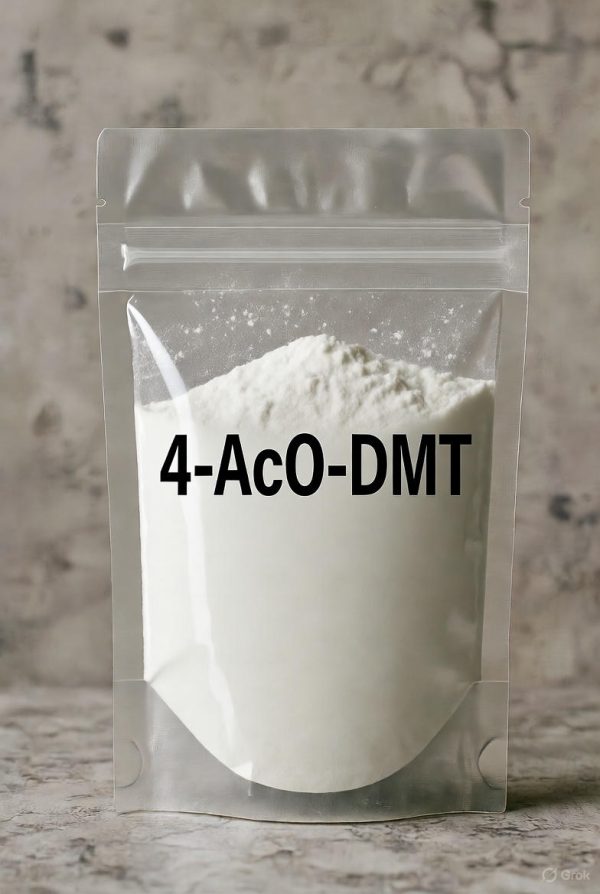
It is a whitish brown powder in its raw form, most often sold in capsules or tablets.
4-AcO-DMT vs. Magic Mushrooms: Which is Better for Research?
Many researchers now debate whether 4-AcO-DMT or traditional magic mushrooms provide a superior experience. While both substances metabolize into psilocin, 4-AcO-DMT offers several distinct advantages in a laboratory setting. First, the synthetic version eliminates the “chitin” found in mushroom cell walls, which often causes significant stomach upset and nausea. Furthermore, 4-AcO-DMT provides extreme dosing precision that organic fungi simply cannot match. Because the psilocybin content in mushrooms varies wildly between caps and stems, predicting intensity remains difficult. Conversely, 20mg of pure 4-AcO-DMT delivers a consistent, repeatable result every time. However, some purists prefer the “entourage effect” of secondary alkaloids found in natural mushrooms. Ultimately, if you prioritize a clean physical sensation and mathematical accuracy, 4-AcO-DMT is the clear winner for modern exploration.
The Science of Psilacetin: How 4-AcO-DMT Converts to Psilocin
Understanding the pharmacology of 4-AcO-DMT (Psilacetin) requires a look at its role as a “prodrug.” Once you ingest the compound, your body’s enzymes—specifically deacetylation processes—quickly strip away the acetyl group. This reaction transforms the molecule into psilocin, the same psychoactive compound responsible for the effects of magic mushrooms. Consequently, the brain interacts with the same receptors regardless of whether you started with a synthetic powder or an organic fungus. This metabolic path explains why the “trip” feels remarkably similar to a psilocybin experience. Moreover, because the conversion happens so efficiently, the onset is often smoother and faster than waiting for the body to break down raw plant material. Thus, 4-AcO-DMT serves as a high-tech shortcut to the same profound neurological destination.
4-AcO-DMT Microdosing Guide: Benefits and Protocol for 2026
Microdosing 4-AcO-DMT has become a popular strategy for those seeking cognitive enhancement without the full psychedelic “trip.” Because it is a pure powder, you can achieve volumetric dosing accuracy that is impossible with unevenly grown mushrooms. A typical microdose ranges from 0.5mg to 2mg, a sub-perceptual amount that boosts creativity and focus. Furthermore, many users follow the “Fadiman Protocol,” dosing once every three days to prevent tolerance buildup. This schedule allows for a day of heightened flow followed by two days of integration. Unlike caffeine, which causes a crash, a 4-AcO-DMT microdose often provides a gentle “afterglow” of mental clarity. Consequently, researchers find it an invaluable tool for professional productivity and emotional regulation in a high-stress world.
4-AcO-DMT Legal Status: Federal Analogue Act & State Regulations
Navigating the legality of 4-AcO-DMT requires a careful look at the Federal Analogue Act. While the substance is not explicitly listed as a controlled chemical, its structural similarity to psilocin makes it a target for prosecutors. If authorities determine that a person possesses it for human consumption, they can treat it as a Schedule I substance. Furthermore, several states have moved to ban the compound by name to close this loophole. Conversely, some decriminalized cities now treat all entheogenic plants and their analogs as a low priority for law enforcement. Because these laws fluctuate constantly in 2026, you must verify your local statutes before ordering. Ultimately, while it occupies a “grey market,” the legal risk remains real for those who disregard local and federal boundaries.
Mastering the Milligram: How to Precisely Dose 4-AcO-DMT
To dose 4-AcO-DMT safely, you must abandon guesswork and embrace precision. Because the difference between a light mood lift and a total ego-dissolution is only 10mg, a standard kitchen scale is insufficient. You require a high-quality milligram scale ($0.001g$ precision) to measure your material accurately. Alternatively, many researchers utilize “volumetric dosing” by dissolving a known weight of powder into a specific volume of high-proof alcohol or distilled water. For example, dissolving 100mg into 100ml of liquid creates a simple 1mg/ml ratio. This method ensures that every drop contains an exact amount, eliminating the risk of “hot spots” in a dry powder. Consequently, mastering these measurement techniques is the most important step in ensuring a predictable and safe research session.
Purity Matters: How to Read a Certificate of Analysis (COA)
A Certificate of Analysis (COA) is your only true guarantee of safety when purchasing 4-AcO-DMT. A legitimate COA comes from a third-party laboratory and details the exact purity percentage of the batch. First, check the “Assay” section to ensure the product is at least 98% pure. Next, look for a “Heavy Metals” and “Residual Solvents” screen to confirm the absence of lead, mercury, or industrial chemicals like hexane. Furthermore, verify that the batch number on the COA matches the label on your product. If a vendor refuses to provide this documentation, you should consider it a major red flag. By demanding transparency, you protect yourself from adulterants and ensure that your research is based on clean, pharmaceutical-grade chemistry.
4-AcO-DMT Safety & Contraindications: Medications to Avoid
Before beginning any study with 4-AcO-DMT, you must check for dangerous drug interactions. Specifically, you should never combine this compound with MAOIs (Monoamine Oxidase Inhibitors), as this can lead to life-threatening serotonin syndrome. Furthermore, users on SSRIs (antidepressants) often report a significantly diminished effect, though the combination can still place undue stress on the heart. Additionally, individuals with pre-existing heart conditions or a history of psychosis should avoid tryptamines entirely. Combining 4-AcO-DMT with stimulants or alcohol can also increase anxiety and physical strain. Therefore, a “clean system” is the safest baseline for research. By respecting these contraindications, you minimize the risk of physical complications and ensure your body remains as stable as your mind during the experience.
The History of Albert Hofmann and the Discovery of 4-AcO-DMT
The legacy of 4-AcO-DMT began in the lab of the legendary chemist Albert Hofmann. In 1963, while working for Sandoz Pharmaceuticals, Hofmann and his colleague Franz Troxler sought a more stable version of psilocybin. They successfully synthesized O-Acetylpsilocin, realizing it could serve as a powerful tool for psychiatric research. While it remained in the shadows of LSD for decades, the 21st-century “psychedelic renaissance” has brought it back into the spotlight. Hofmann’s creation is now celebrated for its efficiency and elegance. Furthermore, it represents the bridge between 20th-century discovery and 21st-century precision medicine. By using 4-AcO-DMT, modern researchers continue the work of the pioneers, exploring the depths of human consciousness through the lens of pure, synthesized chemistry.
Storage and Stability: Preventing 4-AcO-DMT Degradation
Properly storing 4-AcO-DMT is vital for maintaining its molecular integrity. This compound is notoriously sensitive to heat, light, and moisture, which can cause it to oxidize and turn a dark brown or black. While this color change doesn’t always mean the product is “dead,” it does indicate a loss of potency. To prevent this, you should keep your powder in an airtight, amber glass vial. Furthermore, store the vial in a cool, dark place—a freezer is ideal if you use a desiccant pack to prevent condensation. If you use the volumetric liquid method, ensure the solvent is high-proof ethanol, as water can lead to faster degradation over time. By following these storage protocols, you can preserve the shelf life of your research material for several years.
4-AcO-DMT Testing Kits: Using Ehrlich and Marquis Reagents
You should never trust the identity of a white powder based on appearance alone; instead, use Ehrlich and Marquis reagents. The Ehrlich reagent is a “presumptive test” for indoles; a drop on a small sample of 4-AcO-DMT should turn purple within minutes. If it remains clear or turns a different color, the substance is not a tryptamine. Subsequently, use the Marquis reagent to check for common “fakes” or dangerous additives like amphetamines or bath salts. Furthermore, always use a fentanyl test strip as a final safety check, as cross-contamination in labs can occur. While these kits cannot tell you the purity, they are essential for confirming the identity of your compound. Ultimately, testing is a non-negotiable ritual that separates responsible researchers from those taking unnecessary risks.
4-AcO-DMT: Specs & Technical Details
Chemical Name
4-Acetoxy-DMT
Level of Risk
Low
Other Names
Synthetic Shrooms, Psilacetin, 4-acetoxy-DMT, or 4-AcO-DMT
Most Common Side-Effects
Anxiety & Paranoia
Duration of Effects
2–6 hours
Legality
Illegal in most countries, legal in Canada</td>
What Does 4-AcO-DMT Feel Like?
In general, 4-AcO-DMT mimics the effects of psilocybin mushrooms. The active ingredient isn’t the 4-AcO-DMT itself — but its primary metabolite, psilocin. This makes 4-AcO-DMT a prodrug of the naturally occurring psychedelic, psilocin.
In lower doses (up to 30 mg), 4-AcO-DMT and magic mushrooms are virtually indistinguishable. It produces auditory and visual hallucinations, enhances introspection and existential thought processes, suppresses the default mode network (DMN), and alters the perception of time and sensory information.
In higher doses (over 30 mg), the effects of 4-AcO-DMT begin to change. This dose is very powerful and is much more similar to DMT. The visuals become much more fractal and geometric, and the hallucinations and sense of empathy and introspection become very intense.
The existential weight of this substance, especially in higher doses, is one of the main reasons why so many people only use this drug once. High doses of 4-AcO-DMT are much more likely to cause terrifying or uncomfortable trips than high doses of magic mushrooms, but it isn’t clear why this is the case.
Through our trip surveys, we’ve received 11 reports of people using 4-AcO-DMT. Most people took between 20 and 30 mg and reported the effects to be very similar to magic mushrooms but a bit mellower.
Common Reported Effects from 4-AcO-DMT:
Introspection
Altered perception of time
Fractal geometric patterns
The perception of music changes, sometimes for worse, sometimes better
Full-body floating sensation
Euphoria
Ego-dissociation
How Long Does 4-AcO-DMT Last?
One of the main differences between 4-AcO-DMT and shrooms is the duration of effects. This substance can last anywhere from 2 to 6 hours. Only in very rare cases does it last a full 8 hours like magic mushrooms.
If you take 4-AcO-DMT on an empty stomach or snort the powder rather than consume it as a capsule, the effects are going to begin and end sooner.
For example, if you take 4-AcO-DMT in capsule form, expect it to take up to 45 minutes to start taking effect. Peak experience begins around the 2-hour mark, which gradually tap